
Life Cycle Analysis
An ecosystem model for industry, tracing materials and energy through a product from raw material to final fate.
Industrial ecology is a relatively new discipline, especially when placed in the context of terrestrial ecology. An industrial ecosystem includes the interaction of a group of industries involved in the extraction and processing of raw materials, the primary and secondary production of products, and their use and final fate, as Graedel and Allenby described in 2002.
Life cycle analysis is a tool in industrial ecology used to quantify the environmental burdens associated with a product, process, or activity by identifying and quantifying the energy and materials used and the waste released to the atmosphere. In essence, life cycle analysis is an ecosystem model that simulates the flow of one or more materials, such as carbon dioxide, water, or solid waste, through an industrial ecosystem.
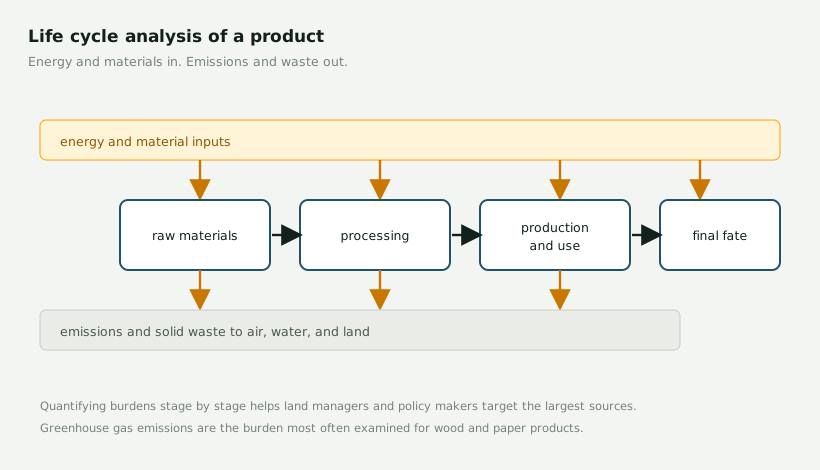
It is increasingly important to consider the industrial forest carbon cycle, because humans harvest the forests and transport the wood fiber to production facilities where the carbon is stored in wood and paper products or used as feedstock for biofuels, as Gower and colleagues described in 2003. Few life cycle analyses exist, because they extend over many sectors of industry.
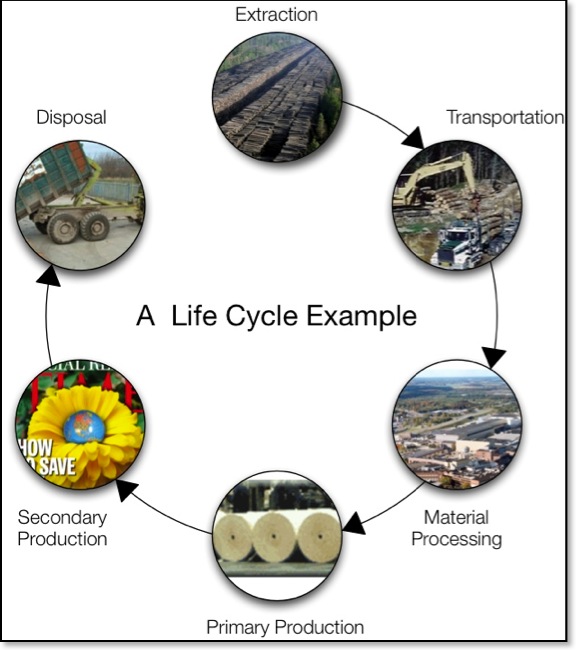
Life cycle analyses help land managers and policy makers identify the major sources of an environmental burden, that is, greenhouse gas emissions, and those data can be used to identify opportunities to reduce such burdens. Examples are gathered under model outputs, including a greenhouse gas life cycle assessment of dimensional lumber and magazines.
If you would like our group to complete a life cycle analysis for you, please contact us. The industrial cycle joins the biological one in the forest carbon cycles overview.